The Practical Guide to B2B Ecommerce
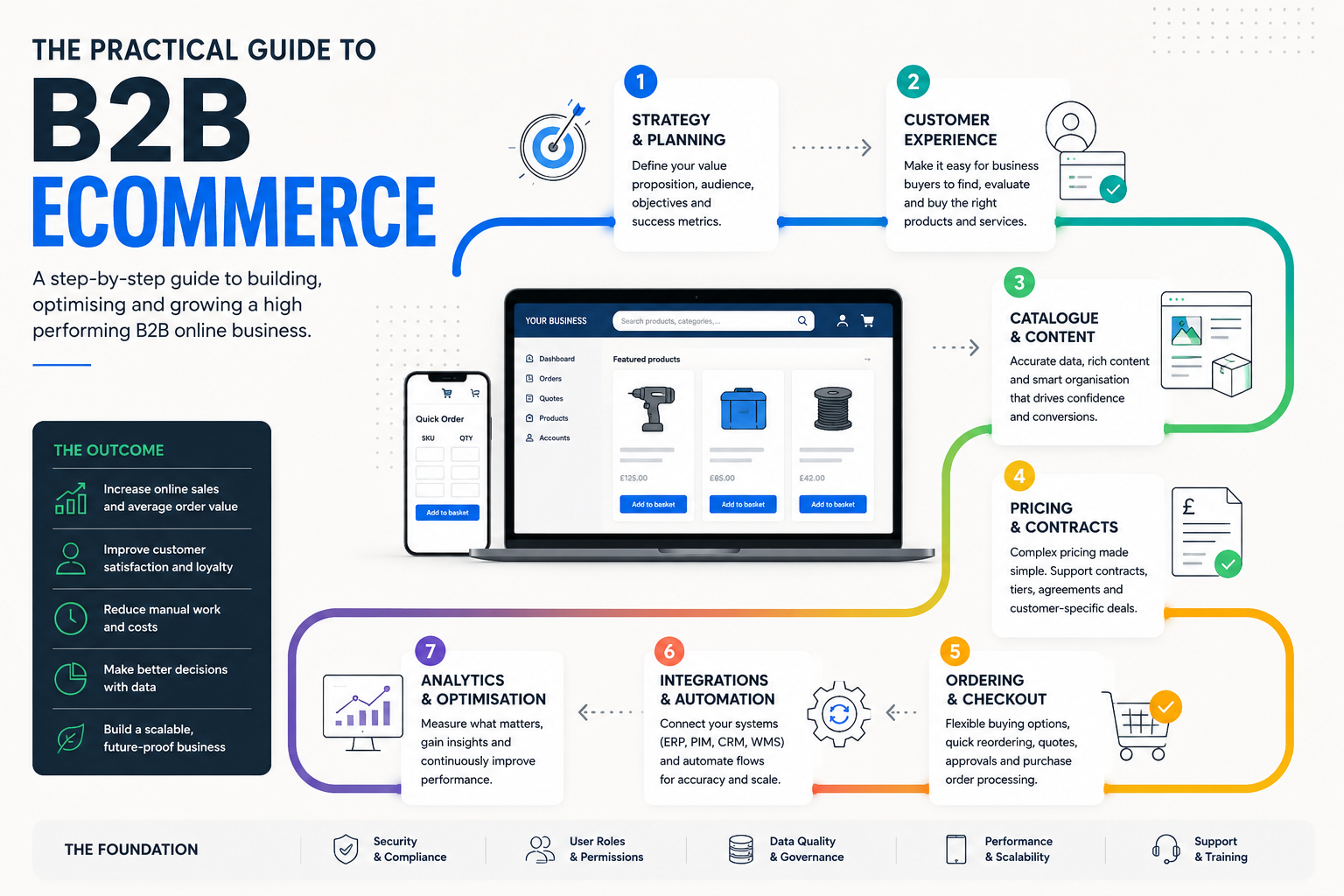
B2B ecommerce has changed significantly over the last decade. What was once seen as an additional sales channel is now a core part of how many businesses operate. Customers expect to be able to research products, place orders, access invoices, check delivery information and manage their accounts online. For many businesses, the question is no longer whether they need ecommerce, but how to make it work effectively.
Despite this, many organisations still struggle to realise the benefits they expected. They invest heavily in platforms, redesign websites and launch new features, only to find that customer adoption is slower than anticipated and returns take longer to materialise.
The reason is simple. Successful B2B ecommerce is about far more than the website. It sits at the intersection of customers, sales, operations, technology and commercial strategy. The organisations that understand this tend to outperform those that see ecommerce as a technology project.
What Is B2B Ecommerce?
At its simplest, B2B ecommerce is the buying and selling of products or services between businesses through digital channels.
Unlike consumer ecommerce, where a single person buys a product for personal use, B2B transactions often involve multiple people, agreed pricing structures, procurement processes and longer-term commercial relationships.
A business customer may have hundreds of employees ordering products through the same account. Different users may have different permissions. Orders may require approval. Payment may be made on credit terms rather than at checkout. Pricing may vary between customers based on contractual agreements.
These differences create a level of complexity that does not exist in most consumer ecommerce environments.
Why B2B Ecommerce Matters
Customer expectations have changed.
The people placing orders for their businesses are the same people using Amazon, Tesco, Booking.com and online banking in their personal lives. They expect information to be available when they need it. They expect self-service. They expect transparency.
That does not mean they want a consumer buying experience copied into a business environment.
Business buyers have different priorities. They want to find products quickly. They want confidence that pricing is correct. They want stock information they can trust. They want access to order history, invoices and delivery information without having to pick up the phone.
For suppliers, ecommerce also creates opportunities to reduce servicing costs, improve customer retention, increase share of wallet and make it easier for customers to do business with them.
The Six Foundations of Successful B2B Ecommerce
Having worked on ecommerce programmes across a range of sectors, I have found that six areas tend to determine success more than any others.
1. Product Data
Product data is often overlooked because it sits behind the scenes.
In reality, it is one of the most important assets in any B2B ecommerce operation.
Customers need accurate descriptions, specifications, dimensions, certifications, compatibility information and imagery. The more technical the product range, the more important this becomes.
Poor product data creates customer frustration, increases calls into customer services and reduces confidence in the online channel.
Many organisations spend significant sums redesigning websites when the biggest issue is the quality of the information being displayed.
2. Customer Data
Understanding customers is equally important.
Businesses need accurate records of customer accounts, users, permissions, locations, pricing agreements and purchasing history.
As organisations grow through acquisition or operate across multiple systems, customer data can become fragmented. This creates problems online where customers expect a single, joined-up experience.
Successful ecommerce businesses invest time in improving customer data before they attempt to transform the customer experience.
3. Pricing
Pricing is one of the biggest differences between B2B and B2C.
Many B2B organisations operate customer-specific pricing models built around negotiated agreements, volume commitments or contractual arrangements.
The ecommerce platform must accurately reflect these agreements while remaining easy to manage and understand.
Getting pricing wrong damages trust very quickly. Getting it right creates confidence and encourages customers to use the online channel more frequently.
4. Integration
Most B2B organisations already have established systems running their business.
ERP platforms manage orders and stock. CRM systems manage customer information. Finance systems manage invoices and payments.
The ecommerce platform sits alongside these systems rather than replacing them.
The quality of integration often determines the quality of the customer experience. If stock levels are inaccurate, pricing is inconsistent or order history is unavailable, customers quickly lose confidence.
Many ecommerce programmes are ultimately integration programmes.
5. Customer Adoption
One of the most common mistakes organisations make is assuming that if they build a new platform, customers will automatically use it.
In reality, customer behaviour takes time to change.
Some customers will embrace new digital tools immediately. Others will continue to order by telephone, email or through account managers because that is how they have always worked.
Successful organisations actively manage adoption. They communicate clearly, train customers where necessary and demonstrate the value of using the online channel.
The aim is not simply to launch a website. The aim is to change behaviour.
6. Executive Sponsorship
This is often the most underestimated factor.
Large B2B ecommerce programmes frequently take longer than expected. Product data needs improving. Systems need integrating. Processes need changing. Customers need migrating.
The benefits may take months or years to fully emerge.
Strong executive sponsorship helps organisations navigate these challenges and maintain focus on the long-term objectives rather than reacting to short-term setbacks.
Common Mistakes
Many of the problems organisations encounter are surprisingly consistent.
Treating ecommerce as a technology project rather than a business change programme is one of the most common.
Another is focusing on features rather than customer needs. Businesses can spend months debating functionality while overlooking basic issues such as product information, search quality or account management.
Some organisations underestimate the effort required to improve data. Others overestimate how quickly customers will adopt new ways of working.
The most successful businesses tend to focus less on technology and more on solving customer problems.
Measuring Success
Online revenue is important, but it should not be the only measure.
Successful B2B ecommerce programmes often deliver value in multiple ways.
They can reduce calls into customer services. They can improve customer retention. They can increase average order values. They can reduce administrative effort and improve operational efficiency.
Looking at a broader set of measures provides a much clearer picture of whether a programme is delivering value.
What Does Good Look Like?
Good B2B ecommerce is usually quite boring.
Customers find products quickly.
Pricing is accurate.
Stock information is reliable.
Orders are placed without difficulty.
Invoices and account information are easy to access.
Problems are resolved quickly.
Customers spend less time dealing with administration and more time running their businesses.
That is ultimately what most business buyers want.
Looking Ahead
Artificial intelligence, automation and digital self-service will continue to influence the future of B2B ecommerce. Search, product recommendations and customer service are already changing as new technologies emerge.
However, the fundamentals remain the same.
Businesses that understand their customers, invest in their data, integrate their systems effectively and make it easy for customers to buy from them will continue to have an advantage.
Technology will evolve. Customer expectations will continue to rise.
The organisations that succeed will be those that remember that ecommerce is not really about websites. It is about helping customers do business more easily.
For all the discussion about platforms and technology, that remains the simplest and most important measure of success.